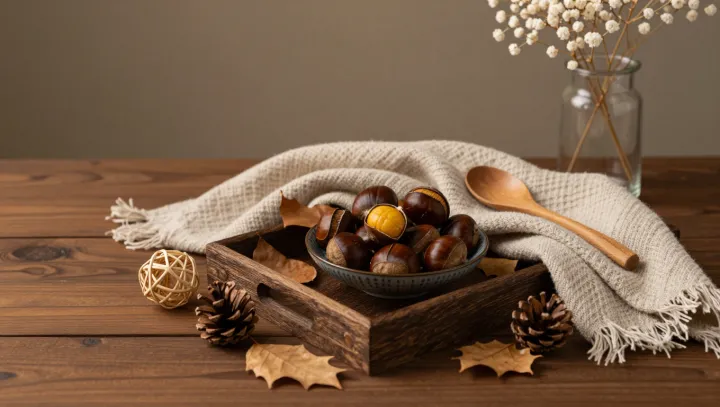
Roasted chestnuts behave like dessert long before they ever resemble one on a nutrition label. Their comfort effect starts in the pan, where heat rewrites their internal chemistry and, by extension, the story your senses tell your brain.
The first trick is texture, not sugar. Chestnuts are dominated by starch, and under high heat that starch undergoes gelatinization and partial dextrinization, turning dry granules into a soft, almost custardlike matrix that the tongue reads as rich even without much lipid. That creamy bite slows chewing, extends contact with taste receptors, and gives modest amounts of natural sucrose and glucose more time to register as sweetness.
The second trick is aroma, which does most of the emotional heavy lifting. As chestnuts roast, amino acids and reducing sugars enter the Maillard reaction, throwing off volatile compounds such as pyrazines and furans that are also abundant in baked bread and caramelized crusts. Orthonsasal and retronasal olfaction then fuse these bakery style signals with the mild sweetness on the tongue, producing a flavor gestalt that the brain files under pastry, not plain starch.
Temperature finishes the job. Warm food enhances both volatility and trigeminal comfort cues, so a hot, fragrant chestnut in a cold hand feels, sensorially, like high calorie indulgence even when the macronutrient math quietly disagrees.