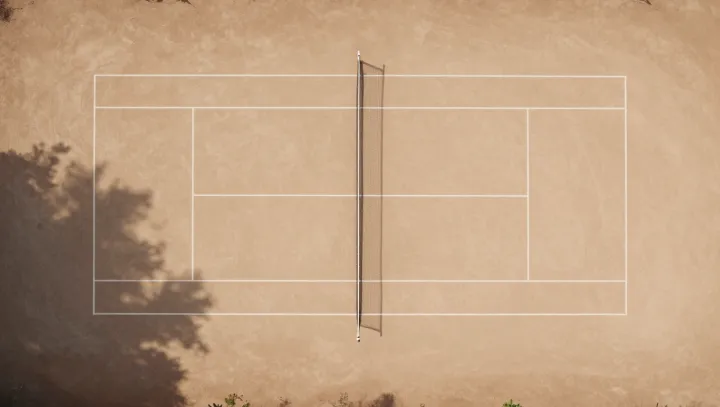
An overhead clay court behaves less like entertainment and more like controlled stimulus. From above, the rectangle, the service boxes, the baseline and the center mark form a strict geometry that mirrors classic psychophysics grids, where line placement is used to test how the visual cortex parses space and boundary.
The striking effect is calm, not chaos. Wide fields of uniform clay activate low spatial frequency processing, which research links to reduced physiological arousal, while the razor-sharp white lines hit high spatial frequency channels that guide saccadic eye movements toward task-relevant zones. That mix allows the brain to ignore crowds, banners and random motion, locking instead onto a simple figure–ground puzzle.
What looks like mere court design doubles as cognitive architecture. Symmetry across the net reduces what psychologists call decision load, because each half of the court offers near-identical affordances, so perceptual attention can narrow onto ball trajectory and spin rather than layout. Color contrast between clay and ball boosts signal-to-noise ratio in the visual field, which in turn supports sustained selective attention. Frozen in an overhead frame, the arena reads like an open experiment on how much order it takes for focus to feel effortless.