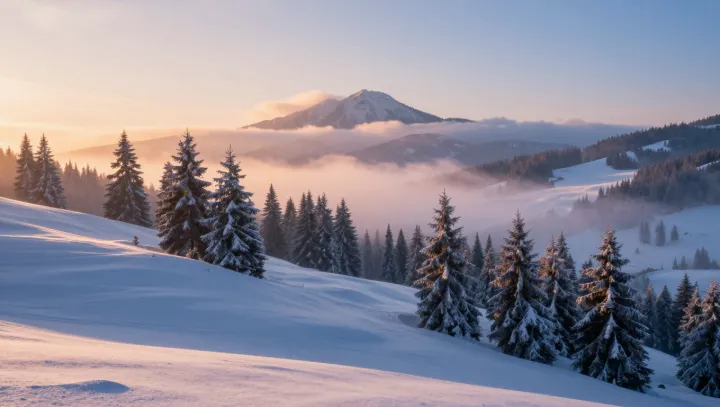
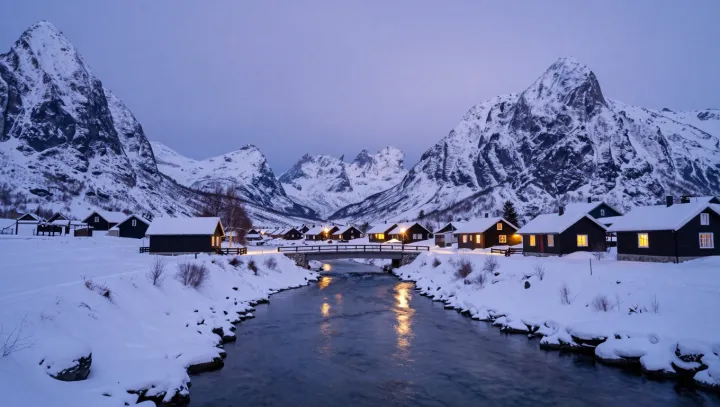
Those viral winter‑village shots are less poetic than they look; they are formulaic visual engineering. A river or snowbank is not scenery but a textbook leading line, exploiting Gestalt continuity to drag the eye from frame edge to steeple or bridge. That single path also reduces cognitive load, a known driver of longer gaze duration in eye‑tracking studies, which in turn boosts algorithmic ranking on image‑heavy platforms.
More calculated still is the glow of windows against blue hour snow. This is not nostalgia; it is color‑contrast exploitation. Warm tungsten or LED interiors sit opposite cold cyan tones on the color wheel, triggering lateral inhibition in retinal ganglion cells and heightening perceived saturation. Viewers read that as intimacy and safety, so engagement spikes even when the village is generic and the architecture interchangeable across stock archives.
Most decisive, though rarely acknowledged, is the valley layout that manufactures depth and scale. A high vantage point, a receding river and stacked rooflines create strong linear perspective and atmospheric perspective in one move, mimicking cues our visual cortex uses for distance estimation. Photographers and influencers keep returning to these three tricks not out of habit, but because they act like a compression algorithm for wonder: minimal variation in input, maximal payoff in perceived magic.