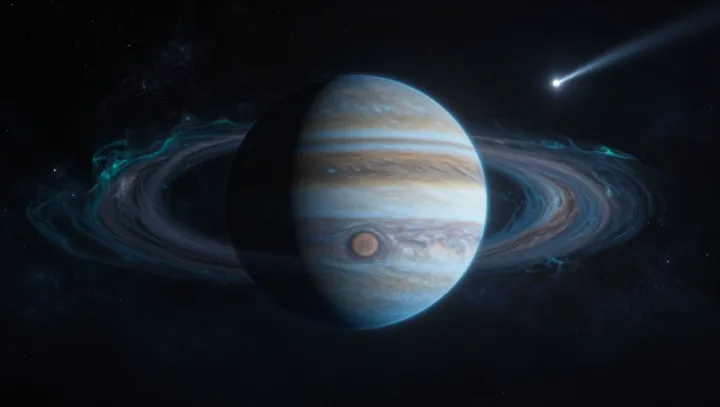
A ghost of ice can win a light contest against a swollen globe of gas. That sounds wrong, yet basic radiative physics makes it almost routine when a comet swings inward and its tail balloons into a vast, sunlit sheet of dust and ionized gas.
The key is not mass. It is cross‑section. A gas giant concentrates most of its reflective area into a single compact disk, while a comet tail spreads grains and plasma over a volume that can span tens of millions of kilometers, each particle intercepting and re‑emitting sunlight through scattering and fluorescence. Integrated over that huge projected area, the total luminous flux toward an observer can exceed the reflected light from a planet whose bright zone is only a fraction of the size, despite the planet’s own thermal emission.
The surprise deepens once albedo and phase function enter the picture. Dust in a comet tail often has high geometric albedo and strongly forward‑scattering behavior, so when the geometry lines up, the tail funnels sunlight almost straight toward the viewer, like a poorly aligned but enormous mirror; the gas giant, by contrast, reflects more diffusely and sometimes hides much of its illuminated hemisphere. Add solar resonance processes such as sodium and cyanogen emission in the coma, and the supposedly minor visitor can, for a brief orbital moment, write its name more brightly across the sky than a permanent planetary resident.