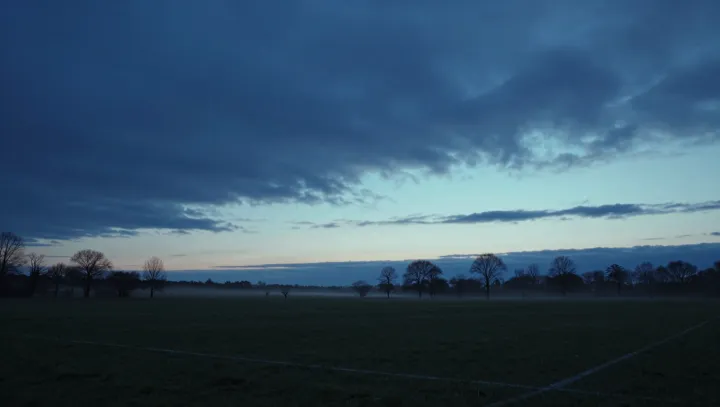
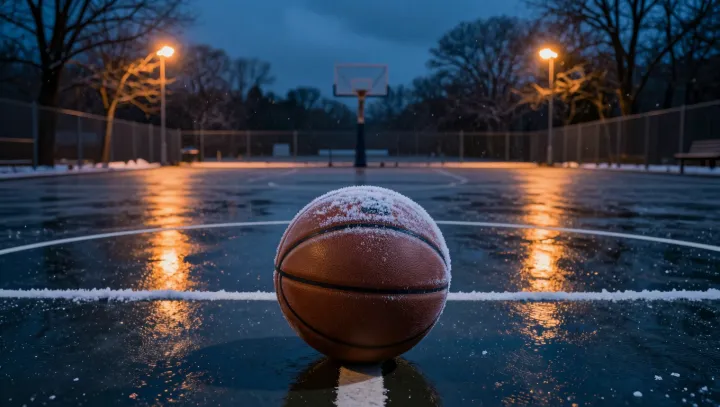
Silence misleads here. The ice‑sealed basketball court looks inert, yet its surface sits on a slow experiment in physics as snowpack compacts, melts and locks itself again into place beneath a pale crust.
This court is not resting; it is negotiating. Under a deep snowpack, individual snow crystals sinter together, a process in which grains bond under pressure and temperature gradients, increasing density and changing how weight is transferred into asphalt and subsoil. That steady load alters stress fields in the pavement, driving microcracks and minute flexing. Between ice layers, meltwater percolates along tiny channels, guided by hydraulic gradients that redirect how water reaches the soil and the shallow groundwater table. What looks like a static sheet becomes a moving lid on a low‑energy hydrologic system.
The more convincing fiction is that nothing happens without players. In reality, freeze–thaw cycles do the heavy work that feet only finish, as liquid water seeps into pores, then expands on refreezing through frost heave, prying open joints and subtly lifting slabs. Each refreeze stores elastic strain energy; each thaw releases it, allowing grains of sand and fragments of aggregate to settle into new configurations. Net change is small. Yet over many cycles, the hoop’s footing can tilt, drainage paths can reroute, and paint can fracture along lines first drawn by temperature gradients, not by games.