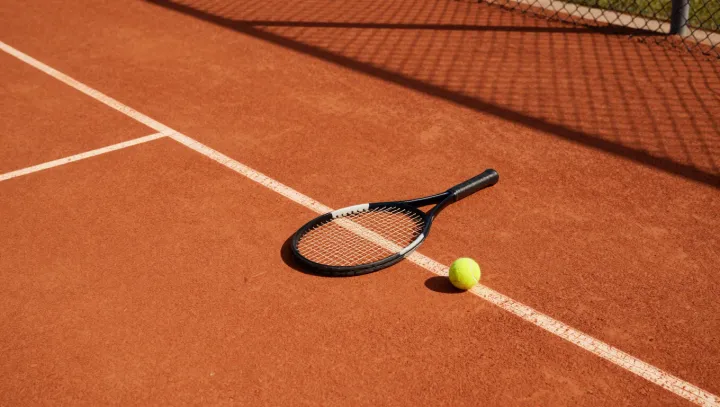
The bright court deceives. Under hard sun, its upper millimeters can look baked solid while still behaving as a mobile bed of crushed mineral that receives a ball rather than merely returning it. That matters most. Clay's loose skin, not the color or glare, begins the slowdown.
Clay steals pace. When a ball lands, it compresses particles and pushes them sideways, spending forward energy on granular deformation, interparticle friction, and a shallow excavation instead of keeping the ball moving cleanly ahead. Contact lasts longer. That extended collision produces a larger friction impulse, which strips tangential velocity, especially when topspin drives the ball downward and forward at once. Spin pays dearly. Kinetic energy becomes heat, particle motion, and sound, while the disrupted layer reduces the coefficient of restitution that would otherwise send the ball back with pace.
Sun is no cure. Brightness can dry the surface, but it does not fuse mineral grains into a hard slab; moisture, compaction, brushing, and rolling decide how much the ball sinks and how readily grains shear. Hard courts answer faster. Their rigid base returns more energy through elastic deformation, while grass often lets a ball skid over a firmer, lower-friction foundation than loose clay provides. Maintenance changes the verdict. A freshly rolled, well-watered court may play firmer than a dry, scuffed one because the distribution and binding of surface particles have changed. That is the paradox. Clay's apparent solidity masks a surface built to give way, and in that tiny surrender the rally finds its extra second.