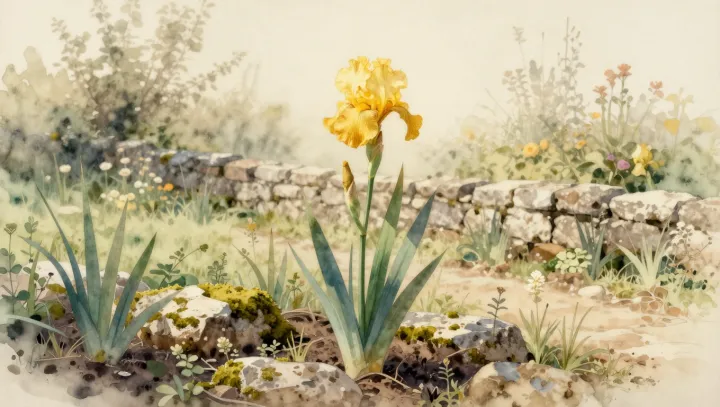
The flower wins here. Against an aged stone wall, a yellow iris throws back wavelengths that the wall largely absorbs or scatters weakly, while its gray-green surface offers little chromatic competition. Your eyes amplify it. At the petal edge, spectral reflectance meets a low-chroma background, so the yellow appears more forceful than it would against a bright, similarly colored field.
This is not decoration. Simultaneous contrast, a stubborn fact of vision rather than a gardeners slogan, makes adjacent colors alter one another in perception: muted gray and green push the iris toward a cleaner, more intense yellow, even though the petal pigment and incident light have not changed. Context bends the verdict. Photoreceptors register incoming light, yet opponent-process coding compares signals across nearby areas, turning a modest gap in wavelength distribution, luminance, and saturation into a sharp visual separation. Differences carry the signal. That comparison does not alter the iris; it alters the visual judgment that gives the iris its apparent intensity.
The wall does half. You can call the iris luminous, yet the wall supplies the trick: its muted gray-green surface leaves yellow in a near zero-sum contest for attention. Nothing mystical is required. Put the same bloom before a yellow fence or a strongly colored border, and its petals lose part of their punch because chromatic contrast, at ordinary viewing distances, governs much of what you see. Would you still stop?