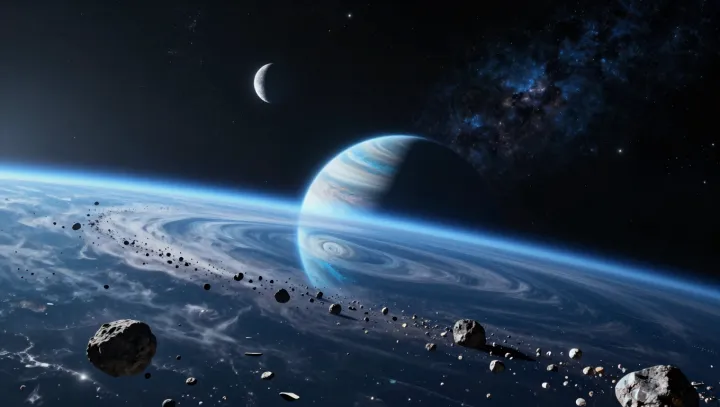
Blue is a trick. You see it when an atmosphere makes short wavelengths scatter more readily than longer red wavelengths, so a planet can wear a blue face without possessing blue ground or blue water. It is not paint. Rayleigh scattering sends shorter visible wavelengths across your line of sight, while aerosols or cloud droplets can alter the result through Mie scattering.
Asteroid fields mislead too. You might picture a bumper-to-bumper hazard zone, yet orbital mechanics usually spreads bodies through volumes so immense that a spacecraft has room to miss them; their apparent crowding often comes from a flat projection against black space. The gaps matter. Low number density, not the sharp silhouette of rocks, sets collision odds, while gravitational resonances can cut lanes where certain orbits fail to remain stable. Even a field with many objects can be mostly emptiness.
The better lesson is uncomfortable. You are looking at two cosmic sales pitches: blue suggests material substance, and a packed-looking field suggests immediate danger, although both impressions arise from light, distance, and geometry. Trust the mechanism. Color is a scattering outcome, while a cluster is a population distributed across a vast volume. That difference decides whether an image informs you or merely impresses you. If you were steering a probe, would you trust the picture or the physics?