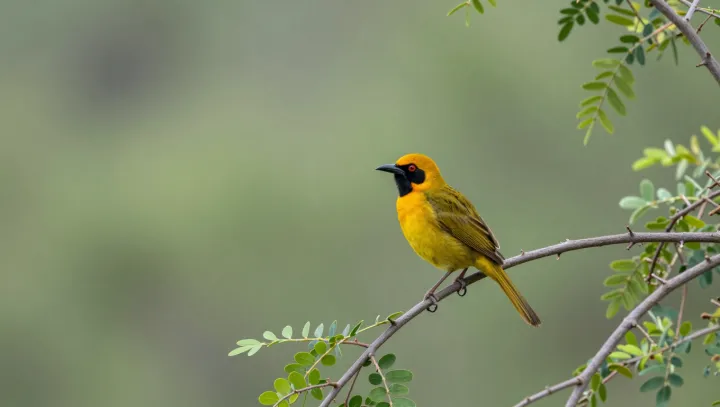
Grass is poor building material, until a weaverbird refuses to treat it as one. A pale strand swings beneath a branch, then disappears under another; each pass converts bendable fiber into a hanging frame, without a claw, tool, or drop of glue.
The trick is structural engineering, not decoration. The beak grips and pulls a strand around a twig, while the feet brace the work and turn the body into a living clamp. A first loop provides anchorage. Then repeated passes exploit friction and tensile loading: downward force tightens the attachment rather than loosening it. Gravity does the audit.
The nest's softness is its defense. Through interlacing, separate grass fibers become a fabric that shares load across many crossings, even when wind rocks the branch or the bird lands at the rim. In many species, a downward-facing entrance leads to a chamber above it, making access awkward for intruders. At dusk, the branch carries what looks like a loose bundle, yet holds a room made by pressure, patience, and exacting feet.