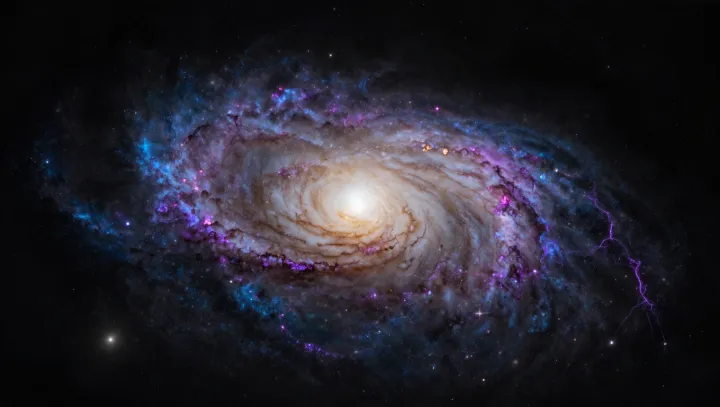
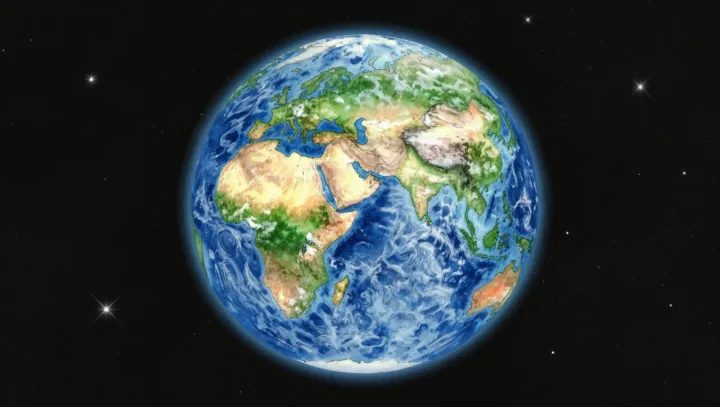
Blue arrives before explanation. Against the star-fog of the Milky Way, Earth can seem to hover alone, although it is moving within that galaxy and carries only a gaseous film whose depth, set against planetary diameter, recalls an eggshell. The effect is deceptive. From afar, no ocean has to supply the familiar color: an observer is chiefly seeing sunlight redistributed by molecules high above the ground.
The picture is backward. Most of the air's mass sits near the surface; the troposphere, where weather works, is shallow beside a world about 12,700 kilometers across. Scale defeats intuition. Even the useful comparison to an eggshell understates a choice: atmospheric thickness depends on whether one measures pressure, density, or the fading edge of molecules. That ambiguity matters. Earth does not wear a shell so much as it retains a gradient, held by gravity and thinned steadily into space.
Blue is not paint. Rayleigh scattering gives short visible wavelengths a statistical advantage when sunlight meets nitrogen and oxygen molecules, sending blue light across the sky more readily than longer red wavelengths. Clouds complicate the verdict. Large droplets favor Mie scattering, which washes sunlight toward white, while a low Sun lengthens the optical path and strips more blue from direct beams. The view remains fragile. Seen beside galactic light, Earth is less a blue object than a lit atmosphere wrapped around rock and water--a color produced by a film nearly too thin to notice.