
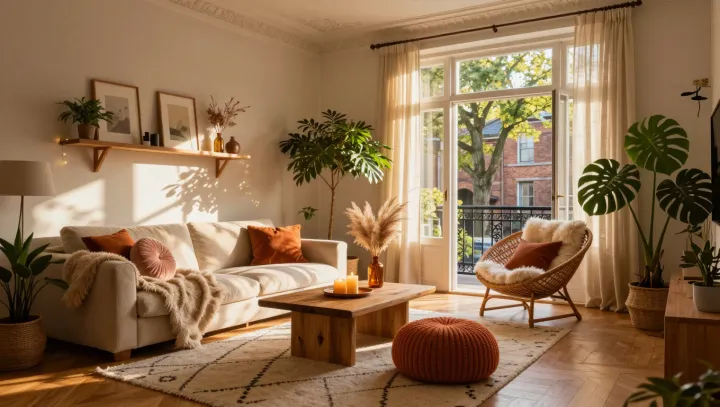
Daylight edits first. It lands across a pale sofa, catches oak grain, and establishes a visual hierarchy before any object asks for attention. Begin with that fact. When the window delivers the first read, the room stops performing and begins to breathe.
More decoration is usually the error. A living room gains stature when boucle, wool, or linen softens the hard edge of furniture, while warm wood gives the eye a low, steady horizon; the point is contrast, not accumulation. Leave deliberate gaps. In biophilic design, material cues can temper a room's perceived chill, but only if their placement remains legible. A textured throw belongs where light can skim it. A crowded shelf turns every surface into an argument. That restraint also protects scale: a large lamp, one chair, and an open patch of floor can read as composed when their silhouettes stand apart.
Calm demands discipline. Let a luminance gradient move from window to interior, reserve the deepest tones for anchoring pieces, and keep circulation clear enough that sightlines do not snag on display. Resist that impulse now. This is not austerity. It is attentional economy, a domestic decision to make the gaze travel slowly rather than defend itself from clutter. The effect is optical before it is emotional; fewer competing edges lower visual noise and give the eye a dependable route through the space. The prize is not emptiness but visual rest: a room where wood holds the light, fabric receives it, and the afternoon seems briefly willing to stay.