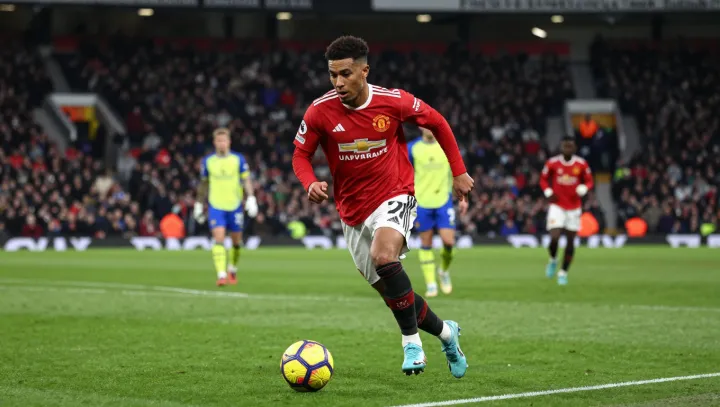
The ball is not a pet. It skips a half-step ahead of the boot, rolling into the patch of grass the runner will occupy after the hips turn. That small separation is the point: elite dribbling is a chain of arrivals, not an act of attachment.
Control begins with permission. A touch that remains under the sole can be safe yet slow; a touch placed beyond it recruits stride length, hip rotation, and center-of-mass transfer without forcing a brake. Proprioception supplies the internal map, while visual-motor coupling updates the ball's line against defenders and open turf. The feet do not babysit. They schedule.
Speed is bought in space. Each well-weighted contact reduces corrective steps, preserves momentum, and leaves ground reaction force available for the next cut or acceleration. Watch the best sequences and the apparent looseness is disciplined: the ball looks free because every projected touch has already accounted for the runner's next stride. The real art lies there, between possession and pursuit.