
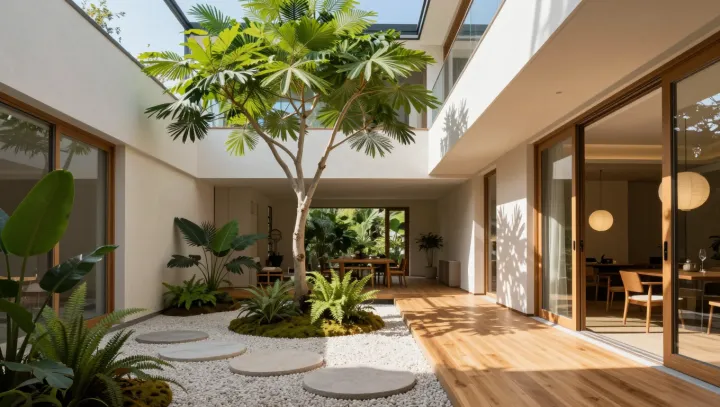
The tree earns its floor area. Beneath a roof opening, its leaves break the hard square of a compact house, while daylight falls down the walls and changes by the hour. This is not indoor decoration. A courtyard is a climate device, staged as a room without a ceiling.
Rarely does a courtyard earn its keep through sentiment. Temperature differences can drive the stack effect: cooler air enters through low openings and warmer air escapes above, provided cross-ventilation paths are not blocked by sealed partitions. Shade cuts solar gain. Foliage screens direct radiation before it strikes glass and masonry; a deciduous canopy can admit more sun after leaf drop.
Small plans gain the most. A courtyard gives adjacent rooms a longer visual axis, making boundaries seem to recede even when the footprint does not. Thermal mass in surrounding walls absorbs and releases heat slowly, smoothing indoor swings when exposure is controlled. Space feels borrowed. At dusk, leaves hold the last light, and the house seems to breathe through them.