
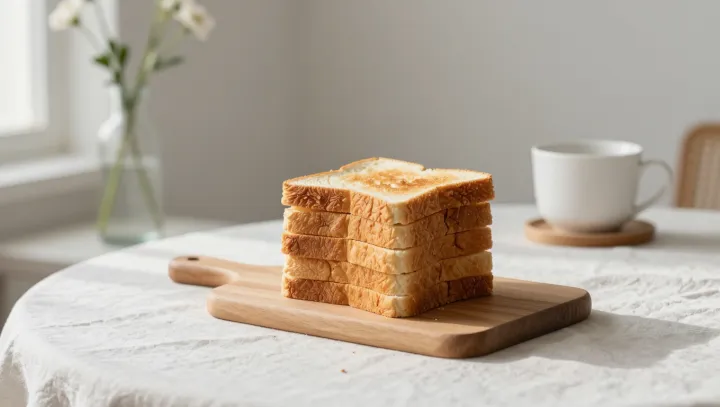
Bread cheats the eye. A slice seems solid, yet its interior is really a three-dimensional foam in which gas pockets carve out most of the volume while a thin skeleton of gluten proteins and gelatinized starch holds everything in place.
This structure is not decorative; it is the product of hard physics and chemistry. During fermentation, carbon dioxide inflates microscopic cells inside the dough, and those cells merge into a continuous gas phase while viscoelastic gluten forms a load‑bearing network that resists rupture. Starch granules swell and then partially gelatinize as heat drives water into their crystalline regions, locking the expanded geometry in place once the oven drive-off of moisture and the setting of protein cross‑links reach a narrow window of stability.
Texture is really engineering here. The contrast between crisp crust and soft crumb follows from heat and mass transfer: the outer layer dries and browns through Maillard reactions, while the interior stays moist enough for the foam walls to remain flexible but not so wet that the network collapses. Change the gas production rate, the gluten content, or the starch gelatinization profile, and the same ingredients stop being bread and start behaving like a dense cake or a rubbery slab.