Those missing four minutes are not a rounding error; they are geometry made visible on a clock. A so‑called 24‑hour day is tied to the Sun, yet Earth does not only spin, it also advances along its orbit. As the planet rotates once, about 360 degrees, it has also shifted a small angle around its orbit, so the Sun is no longer in the same apparent direction. To bring the Sun back to local noon, Earth must rotate roughly one extra degree, which takes about four additional minutes of sidereal rotation time.
The stubborn reality is that a true spin, measured by physics rather than by habit, is shorter than the day people live by. Astronomers define a sidereal day as one complete rotation relative to distant stars, treating them as a quasi‑inertial reference frame. That sidereal day is about 23 hours 56 minutes long, the period a telescope sees when it tracks a fixed star using angular velocity instead of social convention. The civil 24‑hour solar day is therefore a composite: one full axial rotation plus the extra fraction needed to cancel the effect of orbital motion so the Sun appears to return to the same meridian.
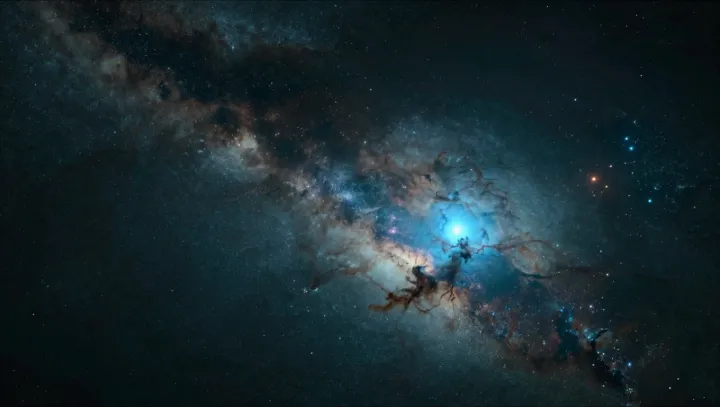
The unsettling part is what this implies about what Earth is secretly turning against. Not the Sun. Not the Moon. The clean, dynamical reference is the background of distant galaxies and stars that define a nearly fixed direction in space, an astronomical inertial frame that underpins sidereal time and celestial mechanics. When the clock says midnight, Earth has just completed another spin relative to that deep backdrop, and only after that does it twist a little farther to satisfy the demand that the Sun look unchanged in the sky.