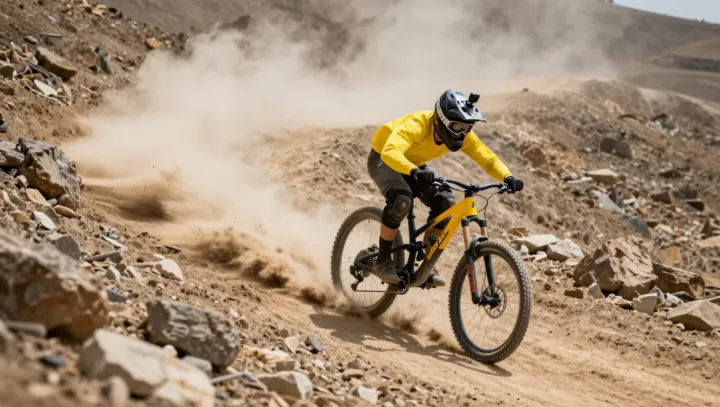
Rubber screaming on rock is not a mistake; it is a strategy. In elite downhill racing, hard braking can be the fastest option, because speed that cannot be controlled through a rock garden or off‑camber turn is wasted speed. By spiking deceleration at specific markers, riders compress the chaos: they kill excess velocity in one violent moment, then free the rest of the section for clean, low‑drag rolling.
What looks reckless is usually a physics audit. Riders use brief loss of static friction to pivot the bike, exploiting the transition to kinetic friction to snap into a new heading that pure grip steering could never reach in time. That controlled skid shortens the path, steepens the effective radius, and sets a better exit angle, so ground speed on the stopwatch rises even if the tire howls in protest.
The deeper logic sits in energy management and contact patch control. Suspension kinematics and tire hysteresis punish riders who carry raw speed into square‑edged hits, because vertical impacts drain kinetic energy and blow the bike off line. By braking harder before the nastiest compressions, riders lower chassis pitch, load the fork and shock into a predictable range, and enter with speed they can actually convert into traction instead of bounce.
There is also a bandwidth problem. Human reaction time and vestibular processing can track only so much chaos. Short, hard braking zones carve mental checkpoints into the descent, letting riders pre‑program lines the way a rally driver commits pacenotes to memory. That disciplined violence on the levers is less about fear and more about creating a trail that exists only for those precise enough to reshape it.