
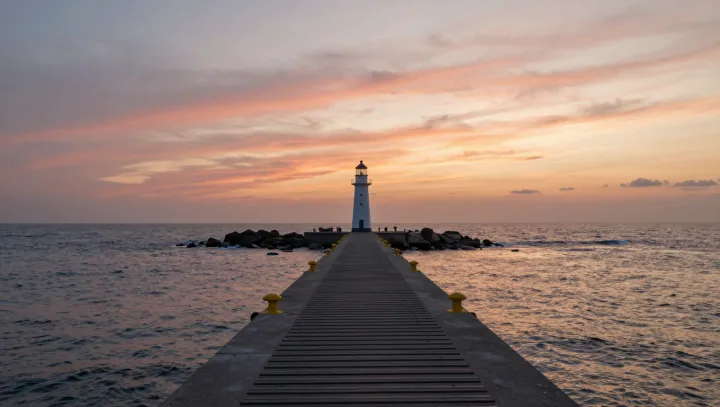
What changes on a pier is not the sky but the geometry. From that narrow spine of wood and steel, the Sun sits at the end of a long horizontal corridor of air and water, a setup that exaggerates color gradients and contrast without touching the physics of the star itself.
The stronger claim is that a pier rewires the optics of your view. Rayleigh scattering, which strips blue wavelengths from sunlight and leaves longer reds and oranges, operates exactly as it does on shore, yet the viewing path from a pier slices closer to the tangent of the atmosphere, extending the apparent column of haze and aerosols along your line of sight, so every extra micron of suspended salt or dust boosts selective attenuation and makes the warm end of the spectrum dominate.
Even more decisive is contrast, not color chemistry. On the beach, bright sand and buildings add stray luminance that washes out low-intensity reds; walk out over dark water and the foreground turns into a giant neutral filter, cutting reflected glare and letting your photoreceptors adapt to lower light, which steepens the luminance gradient at the horizon and deepens perceived saturation of the same physical spectrum.
Perspective finishes the trick. The linear deck of the pier creates forced convergence lines that point straight at the Sun, so your visual cortex treats that vanishing point as a stage, enhancing edge detection around clouds and atmospheric layers; those subtle density variations in aerosols and thin cirrus, which on shore read as mild bands of brightness, out over open water stack into what looks like an engineered color ramp.