
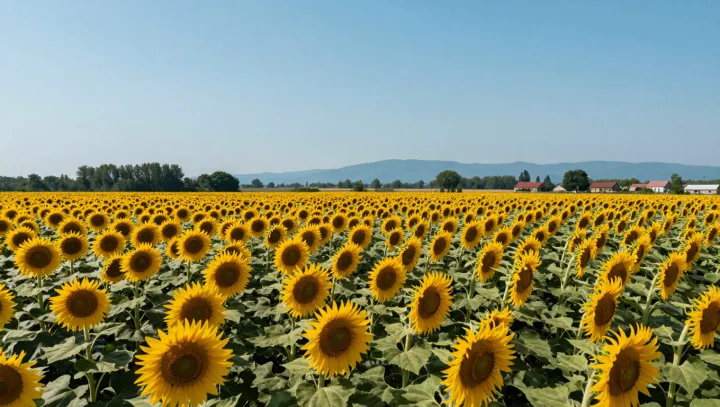
This so-called sun worshipper is faking devotion. Its daily bow from east to west is not reverence but biomechanics, a slow arc driven by minute differences in how stem cells elongate on opposite sides of the stalk under shifting light.
What looks like choice is really a growth script. In the stem, plant hormones such as auxin redistribute as light angles change, creating gradients that push cells on the shaded side to elongate more than their sunlit counterparts, a textbook case of phototropism and differential cell expansion that bends the entire head toward the apparent source of energy. That bend then rebalances internal tension, so the structure never collapses even as it constantly reorients.
The plant behaves less like a worshipper and more like a tracking device. Its floral disk acts as a broad receptor, while the stem functions as a slow actuator, translating molecular signals in the meristem into macroscopic motion that maximizes photon capture, much as a solar array uses a drive system to maintain optimal incidence angles. Underneath the graceful swing runs plain physiology: heliotropic curvature, regulated cell wall loosening, and a feedback loop between light perception and stem biomechanics.