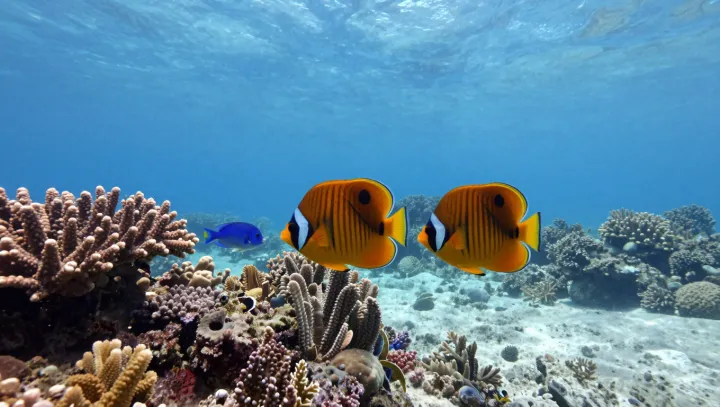
Those fat black bars look like a mistake. Against bright water and white sand, a butterflyfish painted in high contrast should read like a target. Yet the stripes work because predator eyes do not see fish first; they see edges, gradients, and sudden changes in luminance, all processed by specialized retinal ganglion cells that hunt for borders.
The stripes, especially when they slice through the eye and tail, corrupt that border search. One dark band fuses with reef shadows, another with the fish’s own outline, so the brain of a hunter cannot lock onto a single continuous contour. Instead of one body, the visual cortex receives scattered fragments, each too small or oddly oriented to register as prey, a classic case of disruptive coloration amplified by high-contrast patterning.
Clear tropical water makes this trick stronger, not weaker. With little suspended matter, light travels in sharp beams, throwing knife-edged caustics and high-frequency patterns across rock and coral. Refraction and specular reflection on fish scales generate their own bright streaks. The printed black stripes slot into this existing noise field, masking the true body margin and even shifting the perceived position of the fish by bending apparent edges just enough to buy a heartbeat of confusion.