
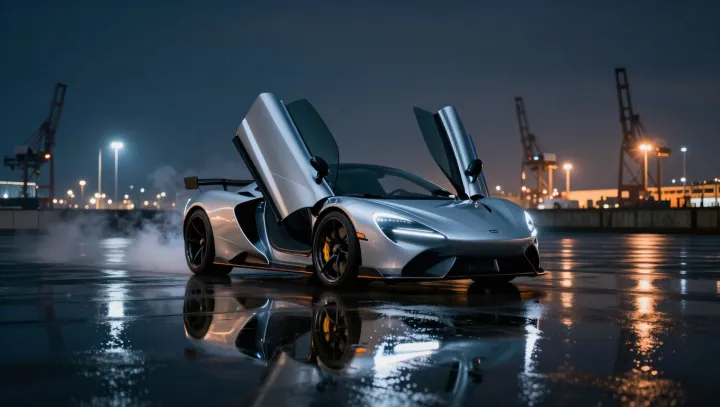
Air should win. A low supercar with scissor doors raised looks like a bad physics joke, vertical slabs catching flow where aircraft use wings. Yet the car stays planted because its core aerodynamics aim down, not up, and the doors sit in a carefully managed pressure field near the body.
Stability starts underneath. Ground effect and a flat underbody generate negative lift, while a diffuser and rear wing bias the pressure map so the resultant force pins the chassis to asphalt. Even when the doors open, that dominant downward vector, backed by a low center of gravity and wide track, overwhelms the messy vortices they create along the flanks.
The doors themselves are weak wings. Their vertical orientation, short span, and near-body hinge line keep their effective angle of attack small, so they add drag and side force, not meaningful lift. Computational fluid dynamics and wind-tunnel work tune mirror shapes, A-pillar curvature, and door gaps so flow reattaches or sheds in predictable ways instead of flipping the car sideways.
Electronics finish the job. Stability control, yaw sensors, and wheel-speed feedback watch for any spike in side slip or steering correction as drag asymmetry grows. Makers then lock out high-speed door operation or cap the allowed opening angle, turning those dramatic panels into controlled air brakes rather than accidental aircraft surfaces.