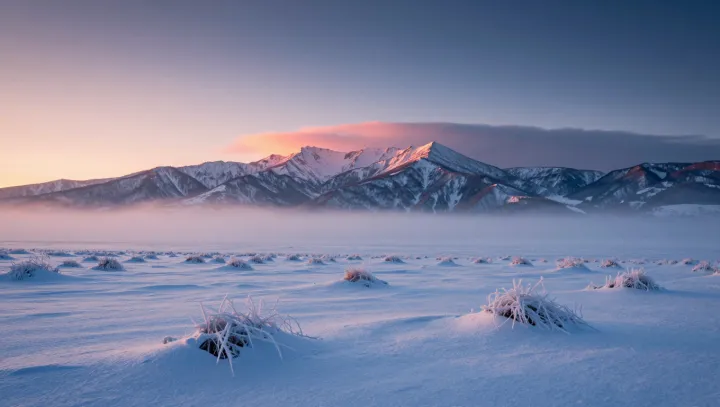
Orange on frozen white is not a contradiction; it is geometry made visible. When the sun sits only a few degrees above the horizon, its radiation must cross a long slant path through the atmosphere, and that extended path filters light very differently from a high midday sun.
Counter to intuition, that glow says almost nothing about warmth on your skin. Along the shallow path, Rayleigh scattering strips away much of the shorter blue and violet wavelengths, so the direct solar beam arriving at high ridges is enriched in red and orange components while the actual energy flux, measured as irradiance, remains modest in cold seasons.
More striking still is what the snow itself does to that beam. With high albedo in visible wavelengths and a microstructure of ice crystals that efficiently reflect and refract incident light, snowfields act like tilted projection screens, bouncing the warm-colored portion of the spectrum toward an observer while losing most of the incoming energy back to space instead of storing it as sensible heat.
The air stays bitter, the ground stays locked, yet the color feels misleadingly hot. Human vision is wired to map longer wavelengths onto a sense of warmth, so the orange cast, driven by atmospheric optical depth and surface reflectance, tricks perception even as thermometers and energy budgets insist on deep cold.