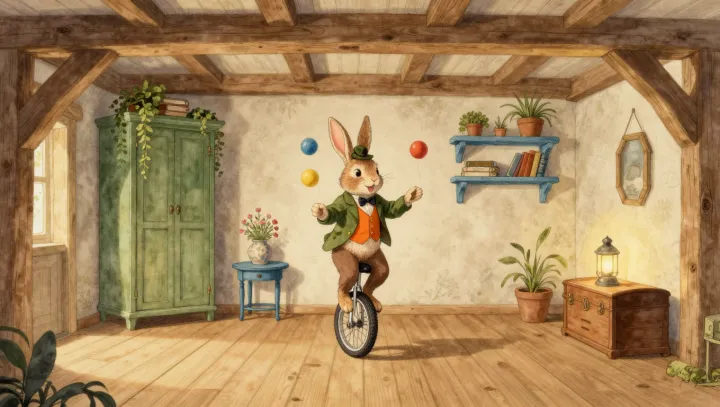
A lone rabbit on a unicycle beats an hour of expert commentary. Not because it is cute, but because it hacks how the brain compresses meaning. In one absurd frame, visual cortex, motor cortex, and reward circuitry fire together, creating what neuroscientists call multisensory integration and rapid chunking of information.
The stronger claim is this: five seconds with that drawing trains your brain like a high‑intensity workout, while a documentary often behaves like low‑impact cardio. The sketch forces instant prediction error; rabbits do not ride, unicycles do not belong here, balance should fail but somehow does. That surprise spike recruits dopaminergic signaling, which flags the scene as worth encoding, and recruits mirror neurons that quietly rehearse the posture, tilt, and micro‑corrections of staying upright.
The uncomfortable truth for filmmakers is that the still image does what long scripts rarely manage. It delivers procedural knowledge and joy in the same shot. Your motor system simulates the movement arc, your affective circuits tag it as playful, and synaptic plasticity stitches both streams together. One sketch, one instant, and the brain walks away with a tiny, unforgettable lesson in balance and delight.