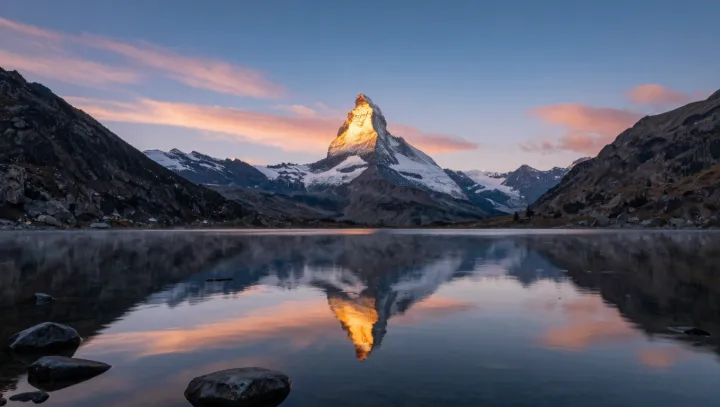

Snow on distant peaks lies about its distance. Under a warm sunset, glowing ridges that sit tens of kilometers away are promoted by the brain into the near neighborhood, because several depth cues that usually keep the scene honest quietly collapse.
Central to the illusion is contrast, not romance. A snow surface has high albedo, so when low-angle sunlight strikes it, the bright peaks punch through aerial perspective that would normally fade distant objects, while the darker foreground loses local contrast and stops advertising its own nearness. At the same time, atmospheric scattering, dominated by Rayleigh and Mie processes, tints the entire air column orange, so color gradients with distance flatten and the usual blue haze that flags remoteness almost disappears.
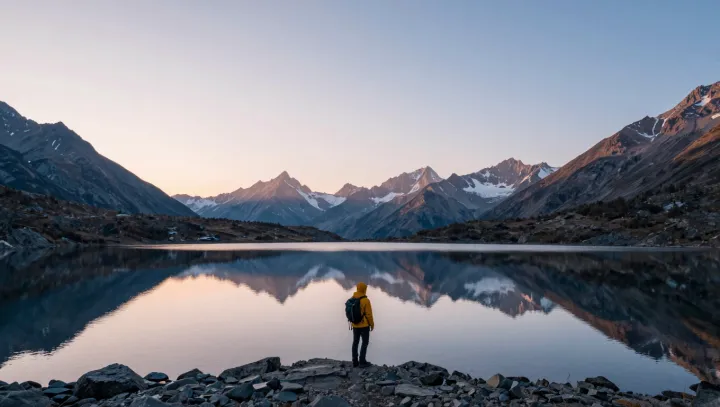
More misleading still is geometry. With no familiar reference objects on the slopes, the visual system cannot run its usual size constancy calculation, so it scales the glowing mass as smaller and therefore nearer. Telephoto lenses and cropped phone images then stack ridgelines into a compressed perspective, stripping linear perspective cues that might restore order. What remains in the frame is a bright, sharp, low-contrast-defying wall of snow, and the brain, starved of reliable metrics, takes the easy option and pulls the mountains toward the viewer.