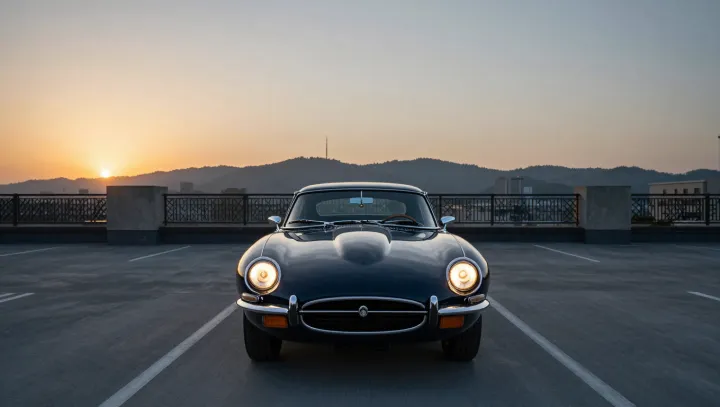
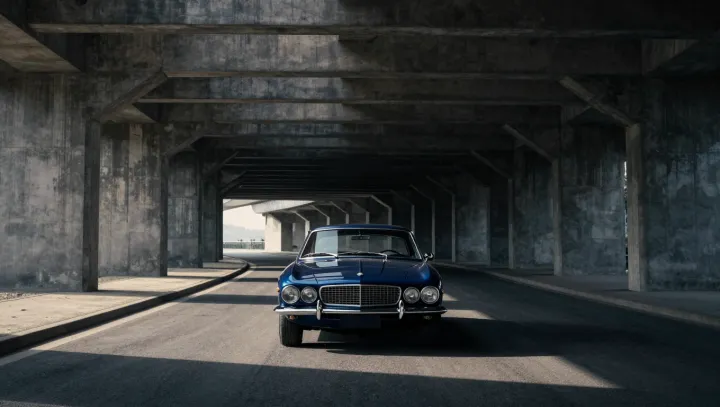
Light catches the front fender, then runs for what seems an extravagant distance before it meets the windscreen. That delay is the trick. A grand tourer announces speed through proportion, because the eye reads a long dash-to-axle ratio and a low greenhouse as stored forward thrust, even when the tires are still.
The rear-set cabin is not decoration; it is a calculated imbalance. By shifting the passenger cell toward the driven wheels, designers leave a broad mechanical forecourt ahead of the driver, a cue inherited from cars built around large engines and long transmission paths. The resulting negative space makes the nose feel like an arrow already released. Physics does not agree. Perceptual psychology does, because expectation converts mass distribution into imagined acceleration while cultural memory supplies the missing engine note.
The effect is almost dishonest, and that is its enduring charm. Low rooflines compress the body vertically, while a wide track gives the eye a stable base from which the tapering tail can seem to escape; together they manipulate perceived center of gravity rather than actual vehicle dynamics. The illusion depends on visual tension, not deception alone: the wheelbase promises distance to cross and the cabin seems to brace against it. Parked under a streetlamp, the car keeps making its silent argument: motion begins in the mind, long before the wheels consent.