
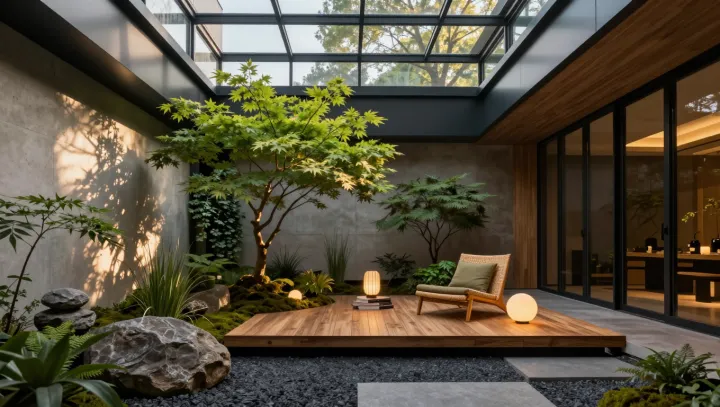
Light does the first edit. As sun moves across leaves and a stone surface, shifting contrast creates a readable edge and gives a compact patio more depth than its footprint owns. Space begins to breathe. Dappled shade also makes a flat boundary appear layered rather than merely narrow. This is not decorative magic: luminance gradients help the visual system separate near from far, while circadian entrainment responds to daylight exposure.
Greenery is the quiet processor. Leaves offer soft fascination, a term within attention restoration theory, because their irregular patterns engage involuntary attention without demanding the directed attention that clutter and hard visual competition consume. The result feels roomy. A planting band works like a graphics processor: it handles visual noise in the background, so the mind spends less effort filtering the scene.
Stone supplies the missing code. Its thermal mass absorbs heat and releases it slowly, which can temper surface conditions near seating, while its weight and fixed geometry provide a visual anchor against the flicker of foliage. Boundaries matter. A low wall or paved plane clarifies where the eye can rest; paired with open sky and filtered light, it can support patterns described by prospect-refuge theory without enclosing the space. The trick is proportion, not accumulation: one tree canopy, a restrained planting layer, and a stone element can outperform a crowded inventory of pots and chairs. As homes compress, the better outdoor room will program daylight, living texture, and mineral mass into a calmer sensory loop.