
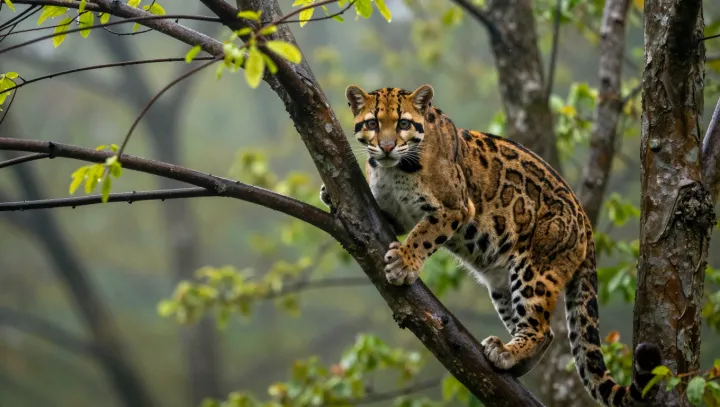
The forest is cheating. A clouded leopard's broad, smoke-colored body appears to break apart when dappled light hits its irregular coat, while its long canine teeth remain irrelevant until the animal turns its head. What looks conspicuous in a clearing becomes visual noise among trunks, vines, and shadow.
Its size misleads observers. The cat is built less like a runner than a compressed climber: short, powerful limbs, wide paws, and an unusually long tail allow deliberate movement through branches where observers rarely search. It moves without drama. Its canine teeth, among the longest relative to skull size in living cats, help secure prey after an ambush; they do not announce the hunter before it strikes. Binocular vision judges distance. Flexible ankle joints and a low center of mass let it descend trunks headfirst, turning vertical forest structure into cover rather than exposure.
Rarity completes the deception. A low-density predator can occupy enormous forest blocks without becoming familiar, especially when its activity peaks at dusk and night and camera traps sample only slivers of its routes. The evidence arrives late. Cryptic coloration, disruptive patterning, nocturnality, and arboreal locomotion create a detection problem that even occupancy modeling struggles to correct when surveys are sparse. So the bulky silhouette disappears. In the leaf-filtered dark, teeth and muscle yield to a harder fact: the animal is present, yet the forest declines to reveal it.