
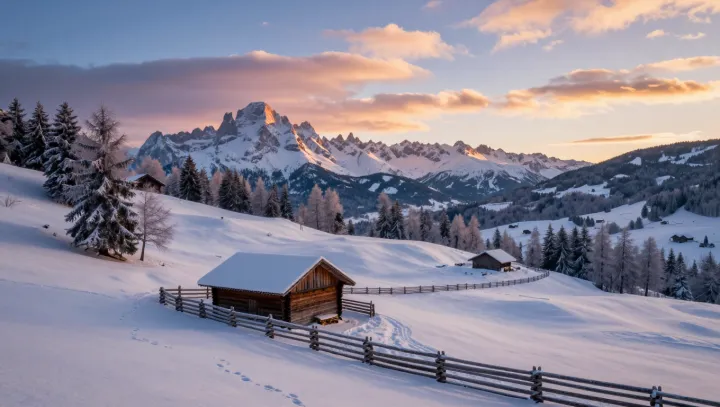
Gold is a trick. As the sun skims the horizon, its low-angle beam crosses far more atmosphere than it does overhead, and Rayleigh scattering strips much of the blue from direct light before it reaches the upper snowfields. The peaks inherit a narrowed, amber spectral irradiance.
Snow is a candid screen. Its high albedo sends much of the arriving radiation back toward the eye, while a granular surface diffuses that return rather than preserving a mirror image. The bidirectional reflectance distribution function of snow is complicated, yet the visual verdict is plain: a warm beam is spread across millions of ice-air boundaries. In radiative-transfer terms, snow is a broad reflector, not a storehouse of golden light. The color arrives with the beam; the snow makes it hard to ignore.
The cabin loses the argument. Its walls, turned away from the setting sun, are fed chiefly by diffuse skylight, whose blue cast arises because Rayleigh scattering favors shorter wavelengths across the vault overhead. A dark roof absorbs more light than snow, deepening the sensed chill without creating blue light itself. Human vision sharpens the split through chromatic adaptation: after the eye accepts the sunlit ridge as its reference, the shaded cabin reads still bluer. Nearby snow can borrow that sky color in shadow. Thus one slope burns while the dwelling chills: two sources of illumination sharing one quiet frame.