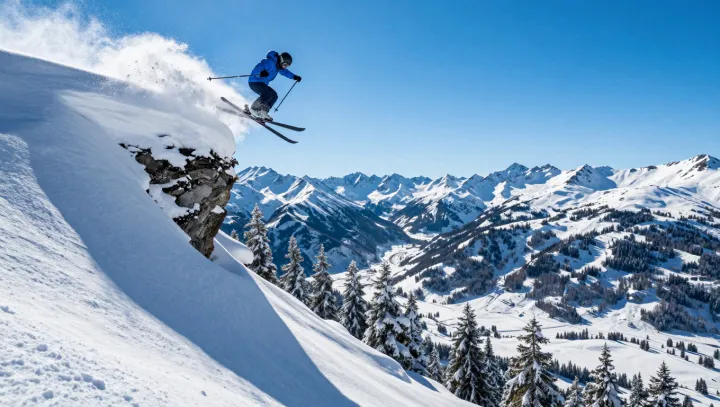
The plume wins the race. At the lip of a powder field, snow lifted by a ski spreads into air whose upward eddies and crosscurrents repeatedly interrupt its fall, while the skier follows a comparatively simple ballistic arc toward the slope. It looks backward. Yet the mismatch is physics, not a trick of vision.
Gravity gets too much credit. A skier is a compact mass, and once takeoff ends, gravity sets the curve of the leap; the slope soon intersects that curve. Snow grains, by contrast, carry little mass for their exposed area. Aerodynamic drag therefore cuts their terminal velocity, especially when powder is dry and finely divided. It is not magic. Turbulent eddies can lift, recirculate, and disperse the grains, making each particle's descent a series of detours rather than one clean fall.
The jump is simpler. Its duration depends chiefly on launch speed, launch angle, and distance to the landing surface, whereas a plume contains millions of grains released with different velocities into a moving fluid. Air is the hidden author. Collisions, vortices, and changing drag separate the cloud from the skier almost at once. Cold air density and snow moisture can alter the effect, yet the basic contest remains unequal. What stays above the tracks is a brief record of motion that escaped the body that made it.