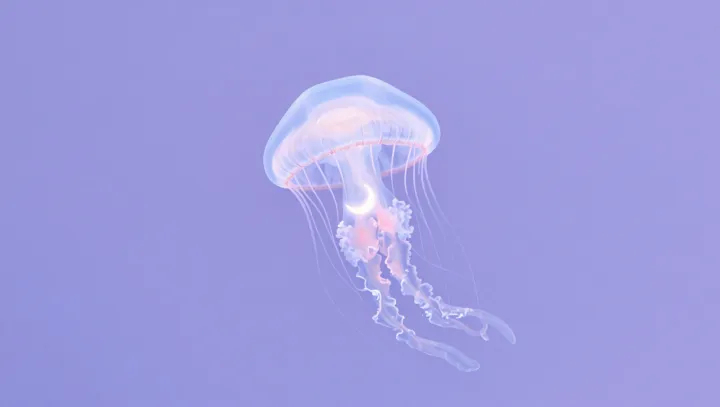
Silence is the trick. Under gallery light, a jellyfish seems less like an animal than a pause made visible: its translucent bell erases hard edges, while slow contractions soften the eye's demand for explanation. Few marine forms offer so little visual clutter and so much room for a viewer to project private weather onto water.
That calm is partly a visual deception. A jellyfish is not idle; bell contraction drives propulsion, and a diffuse nerve net coordinates responses without a vertebrate-style brain. Yet art need not display that labor. The mesoglea, a water-rich layer between tissue sheets, catches and scatters light, turning anatomy into haze. Against blue or black, the animal becomes an unfinished sentence. Its pulse supplies rhythm but declines to furnish plot.
The deep sea does much of the emotional labor. Many jellyfish live nearer the surface, but their cultural link to dark water gives artists a ready field of absence, distance, and concealed life. Not menace but permission is what the creature offers: the viewer can inhabit uncertainty without being pressed to solve it. A pale bell drifts across the frame, and thought follows at its own unhurried depth.