
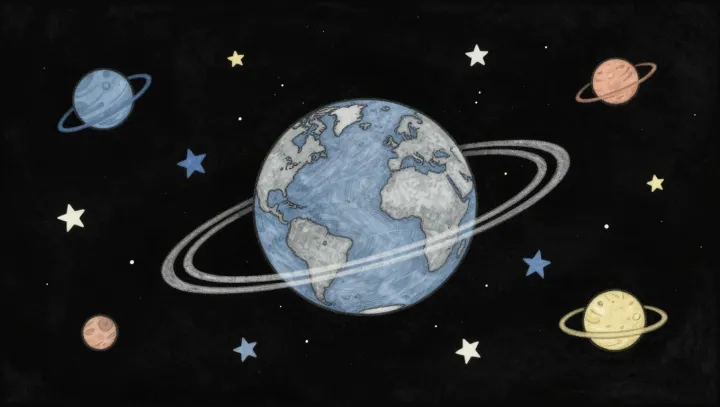
The dome is a persuasive lie. Above a dark field, points of light seem pinned to one shallow ceiling because the eye converts a three-dimensional universe into angular projection. A nearby star and a remote galaxy can occupy nearly the same line of sight, though one sits a handful of light-years away and the other has sent photons across millions.
That visual trick is not a minor error; it is the night sky's governing fact. Parallax exposes nearby stars: shift the observer's position, and their apparent placement moves against distant backgrounds. For greater distances, astronomers read luminosity, spectra, and cosmological redshift, measures that turn faint dots into estimates of distance and recession. The eye sees adjacency. Physics sees depth.
The result is more unsettling than romantic. Light is delayed evidence: a star may be seen as it was years ago, while a galaxy reaches the retina carrying an ancient signal. No vaulted roof contains them. The apparent dome is a projection screen, and each point quietly refuses to share the same present.