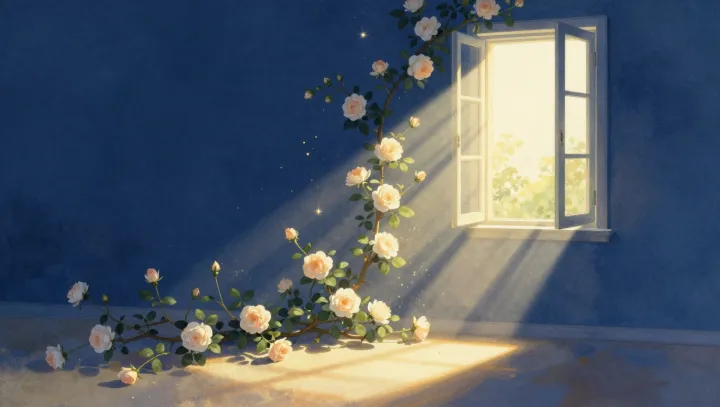
One beam is enough. A hard shaft crossing an illustrated room pulls the eye toward its brightest interval, while the surrounding dark withholds competing signals and turns a modest scene into a frame with consequence. This is not ornament. It is attention compressed into a narrow corridor.
The trick is severe. Because visual salience follows luminance contrast, the illuminated object acquires priority before the viewer has time to inspect its outlines, textures, or narrative clues. Light selects. Chiaroscuro then makes that selection feel charged: a face, cup, window, or empty chair can carry the image because everything else has been demoted into suggestion.
Shadow does the larger job. Where detail states facts, occlusion invites inference, allowing a darkened corner to imply a hallway, a missing figure, or a room extending beyond the frame without drawing any of it. Less becomes larger. The beam gives the eye an answer; the darkness leaves it with a question, and that unanswered space is where an illustration begins to breathe like cinema.