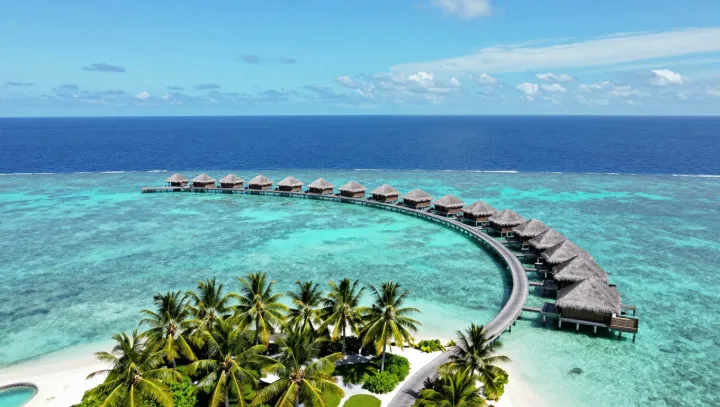
Empty water, not land, is the real architect of the Maldives. Where tourists now see turquoise lagoons, geologists see the ghost outlines of extinct volcanoes mantled by a living veneer of coral polyps only millimeters across, building limestone rims while their volcanic foundations quietly sag under their own weight.
The bold claim is that these tiny animals are less decorators than structural engineers. Each polyp secretes calcium carbonate, grain by grain, forming a rigid exoskeleton; stacked over countless generations, those skeletons create a carbonate platform that can rise fast enough to keep pace with changing sea level, a process first formalized as subsidence theory in classic reef geology. As the volcanic core cools and sinks, rim reefs keep growing upward and outward, locking in the circular footprint of the original island while waves scour the center into a lagoon.
Equally counterintuitive is that the Maldives’ famous clarity is a byproduct of this slow demolition. Parrotfish, boring sponges and urchins grind old coral into fine sediment; currents then sweep much of that carbonate dust away from the reef crest, limiting suspended particles that would otherwise cloud the water, while nutrient-poor open ocean inflow suppresses algal blooms. What remains is a ring of hard reef acting as a biological breakwater, a halo of white sand that reflects light, and water so stripped of plankton and silt that its transparency is now visible from orbit as pale circles on a dark sea.