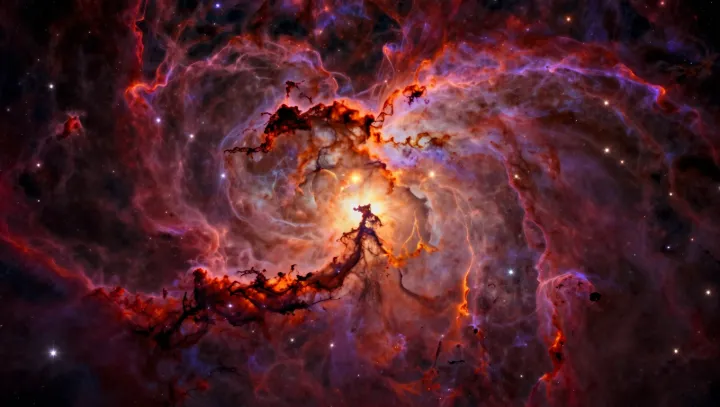
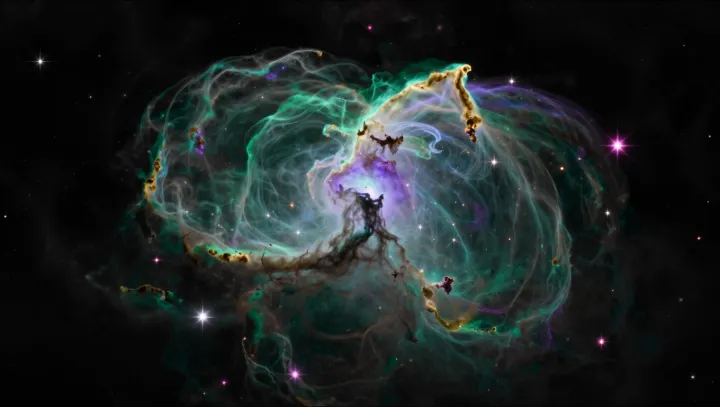
The most common nebula is not a bright cloud at all. It is a ghost of neutral hydrogen spread through the interstellar medium, mute in visible light yet loud on radio receivers tuned to a single spectral fingerprint. That fingerprint, the 21 centimeter line from hyperfine transition in atomic hydrogen, turns emptiness into structure.
The real surprise is how thoroughly optics misled astronomy. Classical nebulae, glowing in H alpha emission or reflecting starlight, looked like the main story, while the bulk of galactic gas stayed effectively dark. Neutral hydrogen neither scatters much optical light nor radiates strongly at those wavelengths, so large radio arrays had to stand in for lenses before its presence could be mapped at all.
What radio telescopes then revealed was not cosmetic detail but architecture. Vast H I regions, traced through Doppler shift of that 21 centimeter line, outline spiral arms, mark density waves, and expose rotation curves that hint at dark matter. Bright emission nebulae became side notes, while the so called invisible hydrogen clouds emerged as the load‑bearing frame of the galaxy.