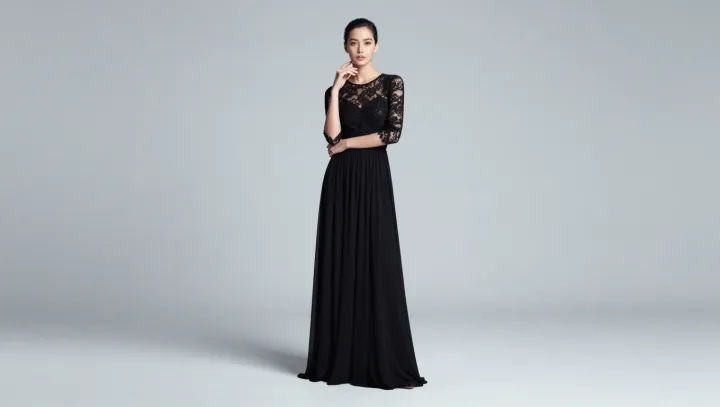
A lace dress can look stricter than a blazer. That tension comes from engineering, not romance: when lace is cut in ultra-clean vertical panels and anchored by a firm lining, it stops behaving like decoration and starts acting like architecture for the body.
The sharpness begins with pattern cutting. Precise princess seams, high armholes, and a close but not tight waist create a clear torso column, so the eye reads one continuous outline instead of a fuzzy cloud of fabric. When the lace motif runs in long vertical repeats, it mimics visual contouring, pulling the gaze up and down and compressing perceived width at the midsection and hips.
Airiness actually helps. A sheer upper chest or sleeve against skin creates strong value contrast, the same principle photographers use with chiaroscuro to carve form from a flat image. Where the lining stops or changes color, a clean edge appears; that edge functions like a drawn line on a sketch, defining shoulder caps, rib cage, and waist notch. When the hem is razor straight and the side seams fall perfectly plumb, the light passing through the lace exaggerates that linear drop, so the body inside feels taller and more contained rather than softened or blurred.
Even movement tightens the effect. Because the fabric is light, it swings close to the body instead of ballooning; the negative space between lace and leg becomes a moving outline, almost like a live tracing. Trim choices then lock the structure in place: a narrow binding at the neckline, a clean zip, a slim belt in a slightly darker tone all act as visual brackets, keeping the silhouette read as intentional, edged, and almost graphic despite the delicate surface.