
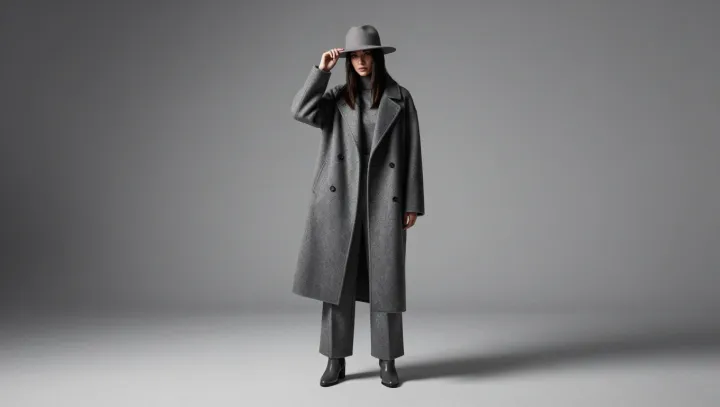
Grey rarely gets credit, yet it quietly runs the show in color psychology. On its own, the shade looks almost like visual static, a near-zero on the emotional scale, but that neutrality is exactly what turns it into fashion’s most strategic amplifier of everything around it.
Stylists argue that grey behaves like a buffer. Because it sits between black and white in lightness, and carries low chroma in colorimetry terms, it cuts glare from brights and softens high contrast without adding its own bias. A cobalt jacket over a grey dress reads cleaner than the same jacket over saturated red, since the eye is not forced to resolve competing wavelengths or clashing cultural codes at once.
The real trick lies in attention economics. Human vision, governed by lateral inhibition and figure–ground perception, hunts for the strongest signal in a scene. Grey provides almost no signal, so the brain discards it as background and locks onto adjacent hues, which appear richer and more intentional. A silver-grey suit next to a scarlet bag makes the bag look bolder; swap in beige and the effect weakens because warmth in the base starts to talk back.
Fashion psychologists frame this as social strategy. Wear grey, and you control the volume of others’ reactions rather than broadcasting your own. The color steps aside; the person, and the accents they choose, step forward.