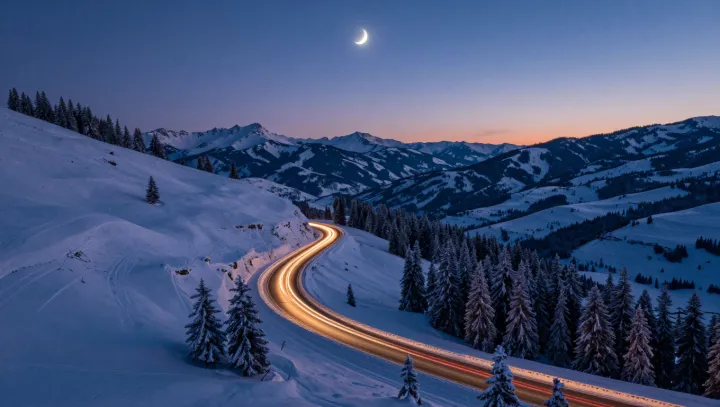
Dark asphalt does not change, yet the camera insists it has become liquid light. On a mountain road, a photographer sets a long exposure, keeping the shutter open while cars crawl along the bends. Each headlamp and tail lamp sweeps across the sensor, not as a single point, but as a continuous trace built up over the entire exposure window.
The trick is simple, and ruthless. Time is being compressed into one frame. Because the shutter stays open, the photosites on the sensor keep integrating photons, adding signal in a process governed by exposure time and irradiance. Where a car’s lamps move, those photosites are hit again and again, accumulating far more luminance than the static rock, snow, or sky, which remain relatively underexposed and therefore sink toward black.
So the road seems to melt. Short bursts of car movement, invisible to the naked eye as a continuous band, are stitched by the sensor into unbroken light trails, an optical trace of motion described by persistence of exposure rather than persistence of vision. No extra bulbs, no LEDs, only existing vehicle lamps leveraged by a slow shutter, wide aperture, and often a low ISO to prevent sensor saturation while that glowing river quietly draws itself.