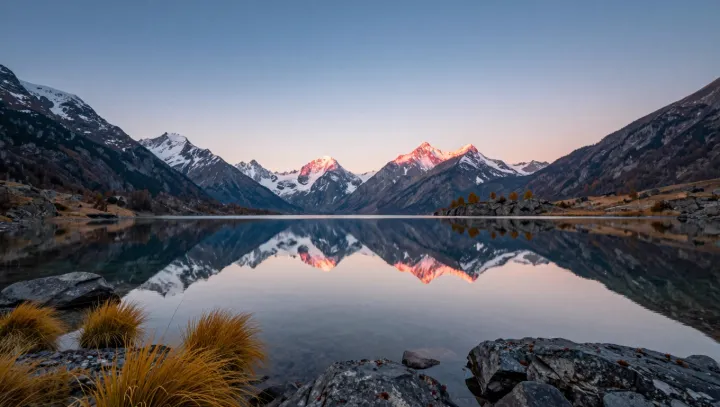
A mountain lake earns its mirror reputation only for a few quiet minutes at the edge of night. Not all calm looks the same to physics, and this short interval is unusually strict. Air cools toward the water temperature, trimming the vertical gradient that fuels tiny convection cells and micro-gusts just above the surface.
That thin thermal balance matters more than most casual visitors would admit. When air and water sit within a narrow temperature range, turbulent kinetic energy in the lowest air layer drops, and capillary waves fail to build. Wind speed must slump below the threshold that generates ripples larger than surface tension can flatten, or the ideal specular reflection collapses into scatter.
Light, not stillness alone, finishes the trick. At low solar elevation, incident rays strike the lake at a shallow angle, boosting contrast between bright sky and dark shore through Fresnel reflection and reducing glare that would wash out detail. Any earlier, the high sun floods the surface; any later, the signal-to-noise ratio in the returning light decays. For a few breaths, geometry, thermodynamics, and optics fall into line, and the whole basin looks less like water than a faultless pane of glass.