
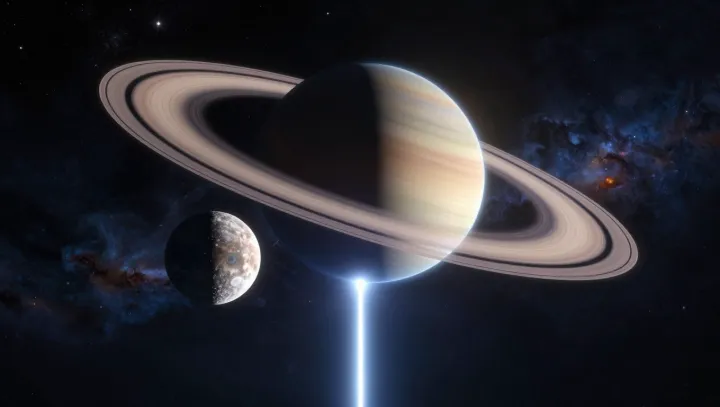
Darkness is overrated as a cosmic eraser; gravity does not care if a star is gone. When a giant planet is kicked out by violent gravitational scattering, its moons sit deep in its potential well, their orbital speeds already matched to the planet’s mass. The ejection changes the whole system’s path through the galaxy, not the tight local dance that keeps those satellites locked in bound orbits.
The surprising part is not that moons stay. The surprise is that some may stay warm. A massive planet still flexes its moons through tidal forces, converting orbital energy into heat through tidal dissipation and viscoelastic deformation of ice and rock. Add radiogenic decay in their interiors, then wrap the surface in thick ice with low thermal conductivity, and a subsurface ocean can persist even when starlight collapses to almost nothing.
Astrobiologists treat these worlds less as dead rocks and more as insulated power banks. Once an ocean exists beneath ice, it does not rely on incident stellar flux but on internal heat flux and orbital resonances that keep tides pumping, a dynamic familiar from Europa and Enceladus. So a rogue planet can drift in perfect night, its skies empty, while a moon below the ice still trades energy with its parent and quietly keeps liquid water in the dark.