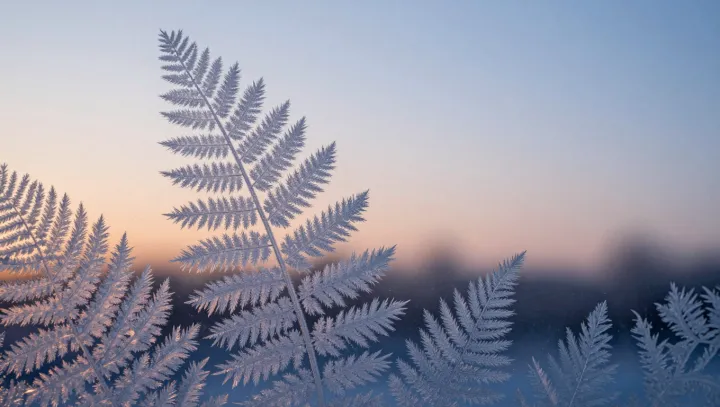
Those feathery frost “flowers” are not artistic accidents. They are strict records of physics, written in ice, as water vapor condenses and freezes along invisible gradients of temperature and humidity across a pane of glass. Where the glass is a fraction warmer, molecules stay mobile a bit longer and spread; where colder, they lock into sharper ridges and spikes.
The surprising part is how systematic they are. Each pattern reflects local heat flow, or in technical terms, a temperature gradient driven by indoor air, outdoor chill and even tiny drafts along the frame. Slight bumps, scratches and residues on the glass act as nucleation sites, seeding hexagonal ice crystals that then branch through diffusion-limited aggregation, the same growth regime that shapes some mineral deposits and metallic dendrites.
What looks like whimsy is closer to a high resolution sensor. The branching angle of each frond, the density of side twigs, the abrupt gaps between “petals” all encode subtle changes in relative humidity and surface energy that would be hard to capture with standard instruments. A single frozen window, left untouched, quietly becomes a precise, self-erasing map of a room’s microclimate.