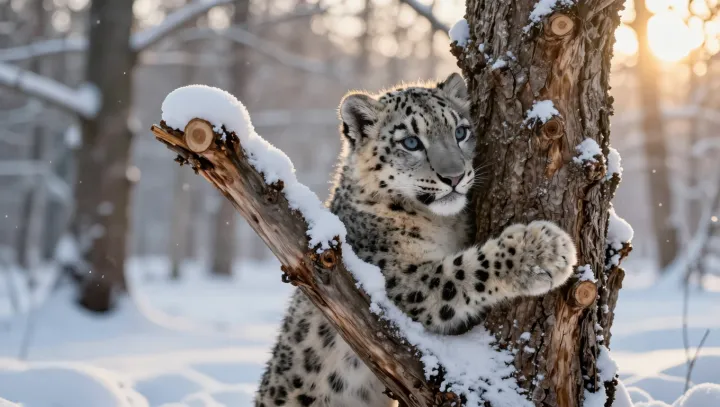
A trunk can become the wiser slope. When powder lies deeper than a cat's chest, a snow leopard may grip bark or settle beside a stem because the mountain's apparent floor has lost its purchase; the slope remains steep, but the substrate has become a trap.
This is less a failure of climbing than a refusal to waste energy. Snow leopards are adapted for rock: broad, furred paws spread ground pressure, while long tails steady rapid turns across ledges. Yet low-density snowpack can collapse under each step, forcing costly postholing and erasing the firm launch point needed for a leap. Trees alter that arithmetic. Their trunks offer a fixed brace; their crowns can intercept snowfall, leaving shallower patches close to the base, although conditions vary with wind, canopy shape, and snow texture.
The tree is not a rival to the cliff; it is an emergency handhold in a bad medium. A leopard may use it to pause, scan, avoid sinking, or gain access to a packed route rather than as ordinary shelter. Context decides everything. If deep snow persists, prey movement, crust formation, and energy balance can make even a rock specialist choose bark. There it hangs, master of stone, conceding for a moment that snow rewrites the mountain.