
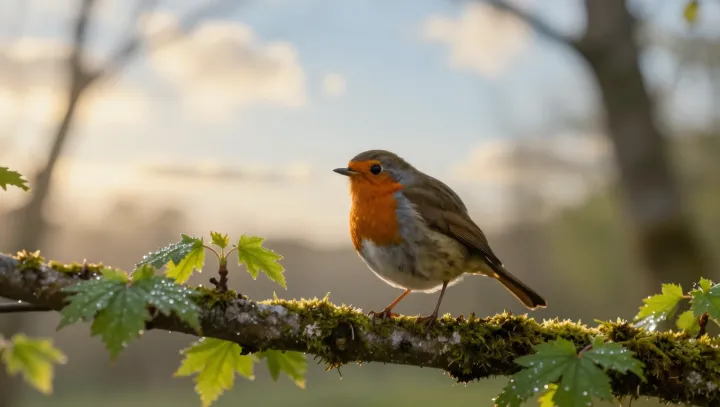
Orange arrives from elsewhere. On a robin's breast, the apparent blaze is assembled not in the bird's cells from scratch but through carotenoid pigments taken from food, absorbed in the gut, altered by metabolism, and laid into growing feather keratin. The bird wears its diet.
That makes the breast less an ornament than an accounting system. Food writes the bill. Carotenoids are lipid-soluble pigments: a robin cannot manufacture them, so its supply depends on prey and fruit carrying those compounds. Fruit and invertebrates can supply pigments, but abundance is only the opening condition. Absorption, transport, and deposition impose their own filters. Once eaten, carotenoids pass through intestinal absorption, circulate with lipoproteins, and can enter growing feather keratin. This is not surface paint. It is molecular inventory embedded while the feather grows. A shortage or bottleneck can limit what reaches the breast, even when pigment-bearing food was eaten.
The familiar patch is more contingent than it looks. Its color can shift with diet, access to carotenoid-bearing foods, and the physiological costs of processing pigments, although shade alone does not supply a tidy verdict on an individual bird's health. Biology resists that shortcut. After a feather hardens, its pigment load is fixed until a molt replaces it. What seems like a permanent uniform is a brief ledger: light catches a feather, and an earlier meal answers.