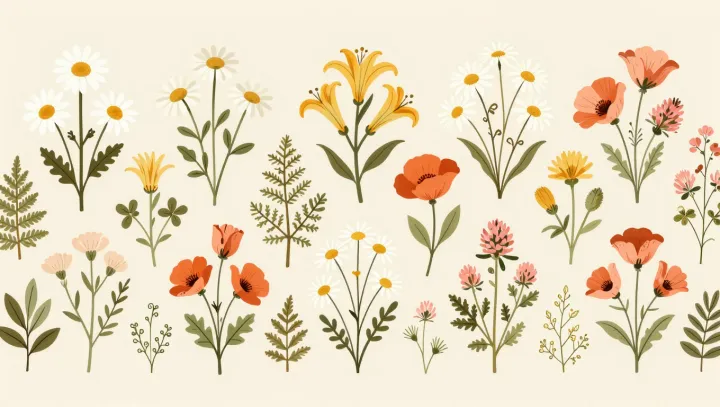
Yellow cups, red spikes, and orange discs seem to command a meadow at noon, yet that command is largely a human illusion: flowers are not composing a view for us but sending spectral signals to eyes built on very different photoreceptors. The field is advertising.
The familiar story is too neat. Bees miss much red. Their trichromatic vision, tuned to ultraviolet, blue, and green wavelengths, can turn a yellow bloom with ultraviolet nectar guides into a target while leaving a red signal comparatively muted. Even petals that appear plain to human eyes may carry contrast patterns at ultraviolet wavelengths, directing an insect toward pollen or nectar. Birds read another code. Many birds have tetrachromatic vision, including sensitivity that makes red and orange displays conspicuous; butterflies and flies bring still other receptor sets. A flower's spectral reflectance is not decoration but a wager on who will carry pollen.
Warmth, then, is a poor ecological label. It works for us. What looks like a unified wash of gold, scarlet, and amber is instead a crowded market of private messages, shaped by pollination biology, ambient light, and the costs of producing pigments. No color wins everywhere. Under the same sun, one blossom may shout to a bird, whisper to a bee, and say almost nothing to a fly. At noon, the meadow keeps its secrets in plain sight.