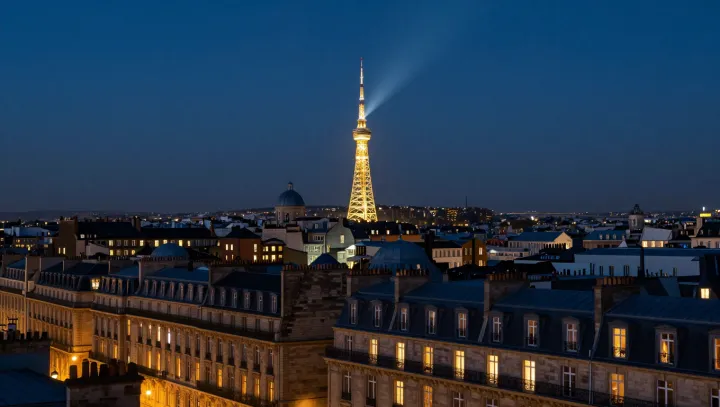
Blue hour cheats the eye. The city looks brighter above than below, yet its stone is already losing heat fast through thermal radiation into a sky that has stopped feeding it with direct solar power. Shorter wavelengths still scatter through the upper atmosphere, so the dome of air glows a cold blue even though the energy flux reaching facades has collapsed.
The counterintuitive part is simple. Surfaces cool as soon as net radiative balance flips sign, and that flip happens before the sky looks dark to human vision. Parisian limestone, with its modest albedo and high heat capacity, has spent the day storing solar energy; now it radiates in the infrared, a band to which your eyes are blind, while the residual blue photons bouncing through Rayleigh scattering remain plentiful enough to trigger cone cells and outshine many early street lamps.
City lights seem weak because their luminous intensity is localized and often filtered, while the sky is a gigantic diffuse emitter powered by the last indirect sunlight plus multiple scattering events. Human photopic sensitivity peaks in the green, but stays high in the blue, so a thin wash of scattered light across the whole vault easily beats a few sodium or LED fixtures. The stone cools. The air glows. Your vision trusts the glow, not the heat.