
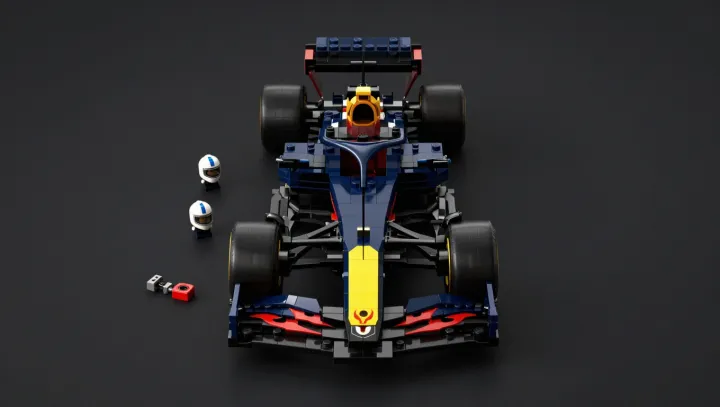
Paint is a decoy. Black and blue streak across the bodywork, yet color contributes nothing to lap time; the decisive work begins where air meets a front wing and splits around its shaped elements. This is not decoration. It is aerodynamic load, built to press the car into the asphalt while it changes direction.
Downforce is the hidden lever. A wing creates a pressure differential across its surfaces, directing air so the resulting force pushes the car downward. Underneath, the floor can matter even more: Venturi tunnels accelerate airflow, reduce static pressure, and use ground-effect aerodynamics to pull the chassis toward the track. Think of it as a pressure-management chip, not a vacuum cleaner; the governing physics remains fluid dynamics and the Bernoulli relationship. A rear diffuser expands the exiting stream, helping preserve the floor's low-pressure field.
Grip always sends a bill. More downforce raises tire normal force, which increases available lateral force and permits the cornering speeds that make Formula 1 look unreasonable. Yet wings and floors create drag, limiting straight-line speed, while turbulent air from another car can disrupt underfloor flow and move the balance. Ride height matters. Small changes can alter the floor's seal, its pressure recovery, and the driver's confidence at turn-in. As simulation and sensing sharpen this feedback loop, the car becomes a rolling airflow computer, reading pressure before a driver can feel it.