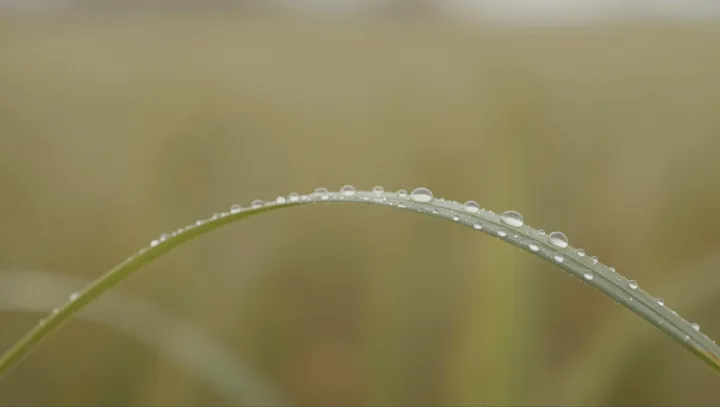
A cool autumn night is not gentle at all; it is a strict referee enforcing the rules of thermodynamics. As grass blades radiate infrared energy into a clear sky, their surface temperature drops faster than the surrounding air, a textbook case of radiative cooling coupled with conductive heat loss from the thin air layer just above.
The key shock is this. Air that seemed comfortably dry was already carrying water vapor near its saturation point at that local pressure. Once the air a few degrees above the grass is chilled below its dew point, the partial pressure of water vapor overshoots what the gas phase can hold in equilibrium, so condensation nucleates on the cooler grass surface, not in empty space.
Dew looks almost magical, yet the optics are blunt. Tiny liquid droplets, far larger than individual molecules but still microscopic, scatter incoming light through Mie scattering, turning a transparent gas into a bright white sheen. Not because more water appears, but because phase change concentrates it into droplets large enough for your eyes to catch.