
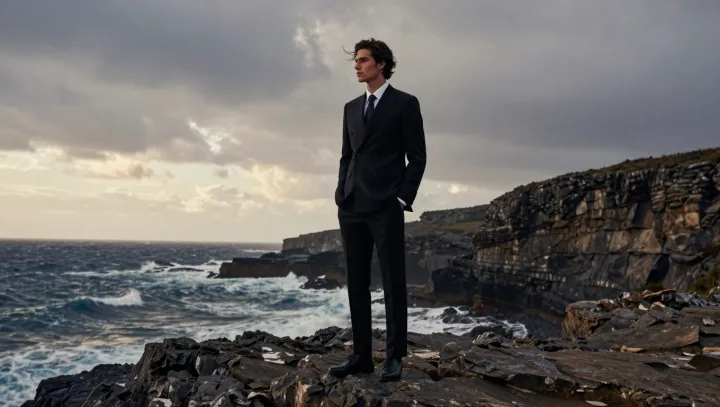
Order wins the frame. Against rain-whipped ridges and fractured cloud, a suit's straight lapels, squared shoulders, and measured seams act as high-contrast visual coordinates, telling the eye that one body remains regulated while the scene refuses regulation. The effect is not magic. It is learned pattern recognition, reinforced by offices, courts, ceremonies, and screens.
The mechanism is social. A suit behaves like error-correcting code, but its scientific correlate is predictive coding, a model of perception in which the brain tests sensory input against prior expectations; sharp tailoring supplies clean edges, bilateral symmetry, and stable proportions, reducing ambiguity when wind, water, and broken horizons compete for attention. Chaos raises the signal. Cultural conditioning then assigns those forms to discipline, institutional rank, and self-command.
Authority travels lightly. It does not prove competence, yet the autonomic nervous system reads upright posture, containment, and low-variance movement as cues of control, while viewers trained by formal institutions attach rank to the same visual grammar. Cloth cannot confer merit. As screens pack attention with alerts, clips, and synthetic imagery, disciplined form could function as a wearable control system, a compact protocol that makes calm legible at machine speed.