
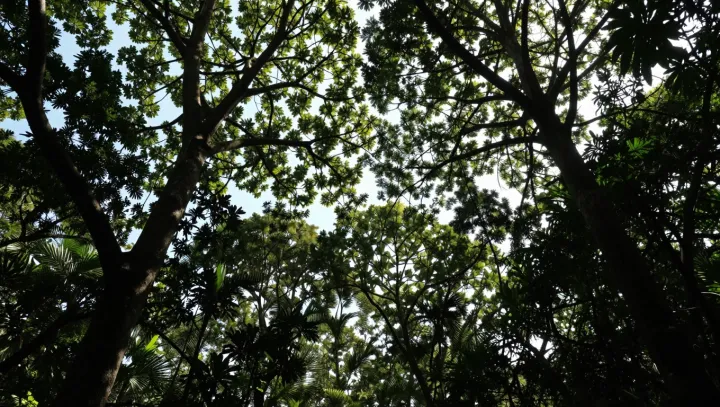
The canopy is a sly optical machine. Beneath a tree, bright disks can appear on the ground because every small gap passes a narrow bundle of rays and turns the surface below into a screen. Look very closely. The disks remain round when the openings are jagged.
This is a brutally efficient optical trick. Each opening acts as a pinhole camera: under rectilinear propagation, rays from the Sun's upper edge cross at the gap and land lower on the screen, while rays from its lower edge land higher, producing an inverted image. Size decides quality. If the aperture is too wide, many ray paths overlap and blur the disk; if it is extremely narrow, diffraction spreads the light and steals detail. During a partial solar eclipse, those circles become crescents, proving that the light source, not the foliage, supplies the outline.
Geometric optics makes this small trick more than a curiosity: a leaf canopy behaves like a low-power optical processor, sorting rays through thousands of apertures without wires or code. Not magic at all. Rectilinear propagation carries the inverted solar pattern, while diffraction softens it when an opening becomes extremely narrow. The effect can scale. Arrays of apertures could route images through thin materials, turning plain surfaces into passive sensing hardware.